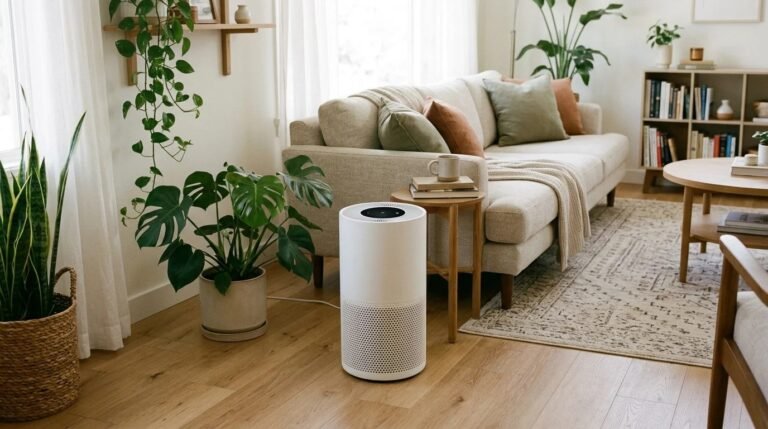



You bought an air purifier, plugged it in and set it in the corner. But is it actually cleaning the air you breathe? Where to put an air purifier makes a bigger difference than many people expect, because the machine can only clean the air that reaches it.
Contents
The right spot is not complicated. It is mostly about choosing the right room and giving the purifier room to breathe.

Where to put an air purifier: the short answer
Place it in the room where you spend the most time, often the bedroom, with open space around it so air can flow in and out freely. Keep it away from walls, curtains and furniture that block the vents. The EPA notes that how well an air cleaner works depends on how efficiently it collects particles and how much air it moves, so good airflow matters.
Why placement changes results
A purifier pulls air in, traps particles in its filter and pushes clean air back out. If it is squeezed behind a sofa, it keeps cleaning the same small pocket of air. In an open spot, it can circulate air across the whole room. The EPA also notes that tabletop units may struggle with strong pollution sources nearby, so size and placement work together.

Good spots vs bad spots
| Spot | Good or bad | Reason |
|---|---|---|
| Bedroom, a few feet from the bed | Good | You spend hours breathing that air |
| Open area in the living room | Good | Air can flow from all sides |
| Near the main source, like a pet bed | Good | Catches particles early |
| Tight corner or behind furniture | Bad | Blocked airflow |
| Right next to a heater or humidifier | Bad | Heat and moisture can affect the unit |
| In a closed room you never use | Bad | Cleans air nobody breathes |

7 easy placement tips
- Start with the bedroom. Most people spend a third of the day there.
- Leave space around it. Keep curtains, walls and furniture away from the air inlets and outlet.
- Raise small units. A small tabletop purifier often works better on a stable surface than on the floor behind clutter.
- Close doors and windows. A purifier works best on a closed room it is sized for.
- Point clean air toward you. Angle the outlet toward where you sit or sleep.
- Keep it away from moisture. Do not place it right next to a humidifier or in a steamy bathroom.
- Match the size to the room. One small unit cannot clean an open-plan floor.
How long should it run?
Most purifiers work best when they run steadily rather than in short bursts, because new dust and dander keep entering the air. Many people leave the purifier on a low or auto setting all day and turn it up when cooking, cleaning or when pollen is high. In the bedroom, a quiet sleep mode lets it work overnight without keeping you awake. Remember the EPA’s advice too: removing the source and opening a window when the weather allows also help.
Should you move it around?
If you only have one purifier, moving it is fine. Run it in the living room during the day and in the bedroom an hour before bed. Just make sure it is sized for the larger room, or it will struggle there.

Quick FAQ
Should an air purifier be on the floor or a table? Large tower units are built for the floor. Small units often do better raised on a stable table with clear space around them.
Can I put an air purifier near a window? Yes, if the window stays closed. An open window brings in new outdoor air faster than the purifier can clean it.
Do air purifiers remove smells and gases? The EPA notes air cleaners are generally not designed to remove gaseous pollutants. Units with activated carbon can help with some odors.
Where to put an air purifier: a quick recap
- Best room: the one you use most, often the bedroom.
- Clearance: open space on all sides.
- Doors: closed while it runs.
- Avoid: corners, heaters and humid spots.
Final thoughts
Once you know where to put an air purifier, you get more clean air from the same machine without spending another cent. If you are still choosing a model, our guide on choosing the right size air purifier will help.
Your turn: where does your air purifier sit right now? Tell us in the comments, and whether moving it made a difference.
This guide is based on EPA indoor air guidance and general product advice, not our own testing. Follow your purifier’s manual for clearance and safety.